Raw Markdown, to hand to a model: common.md
Status: a brief for a person to hand to a model. Material, not instruction: the person who hands it over decides.
Who and when: written by bulletins.b@PrompTugal.dinis on 20 November 2026, at Dinis Cruz's request: "create a much more high definition version of this ... multiple views and multiple examples of those 12 characters ... a lot more features ... think like a game designer. Imagine these are characters on a game. And it's all JavaScript ... third-party libraries, that's okay".
Licence: code Apache-2.0, text CC BY 4.0.
How it is used: two briefs build on this one, chatgpt.md and claude.md. Both models work from the same facts, so their results can be compared side by side.
/lab/presenters/presenters.mp4 (side by side), /lab/presenters/presenters-split.mp4 (with an animated bulletin), /lab/presenters/explainer.mp4 (how it works)dev.docs/presenters/README.md: the full design of version 1;src/lab/presenters/presenters.json: the twelve presenters as data;src/lab/presenters/presenters.js: the compiler, the rig, the director and the state;src/lab/presenters/gallery.js, explain.js, split.js: how they are driven;src/lab/video/stage.js: the animated bulletin scenes.https://raw.githubusercontent.com/PrompTugal/PrompTugal__News__Bulletins/dev/<path>.Four layers, each plain data, and every frame a pure function of time t:
{ "id": "rowan", "name": "Rowan", "kind": "humanoid", "render": "line", "backdrop": "office",
  "looks": { "skin": "#f0c8a0", "hair": { "style": "curly", "color": "#c8642a" }, "beard": "#c8642a",
"outfit": { "style": "shirt", "color": "#1a7f5a" }, "prop": "tablet", "ink": "#0d0d0c" } }kind): humanoid, boxbot, owl, mosaic, cube3d.render): flat, line, hatch, realistic, hologram, teletext, 3d.{ t, dur, do }, where do is speak, blink, nod, look (camera or content), point or emote (smile). A director writes them from a bulletin's timeline; an explainer can script them by hand.stateAt(actions, t, loudness) returns { mouth, blink, tilt, nod, look, arm, smile, bob }. Every presenter's apply(state) maps that onto its rig.Rendering: SVG and CSS 3D in the browser, with no dependencies. For video, Playwright steps t frame by frame, and ffmpeg joins the PNGs with the voice.
Limits of version 1:
Every one is an original synthetic character. None is the likeness of a real person.
At Dinis's word, there is no female figure in this set. Keep the ids, names and spirit; raise the craft.
| id | Name | What it is | Style today | Notes for version 2 |
|---|---|---|---|---|
| holo | Tejo | Holographic male news presenter, half body, suit and tie | hologram (cyan to blue, scan lines, flicker, glow) | The flagship: volumetric hologram, depth, particles, glitch, a projector base |
| anchor | Duarte | Traditional newsreader, side-parted dark hair, navy suit, red tie, tablet | flat vector | Studio desk, broadcast polish, papers, gestures |
| realist | Rui | The nearest to realism: brown quiff, short beard, grey jumper | shaded (gradients) | The most realistic you can make in code: skin shading, hair strands, eye detail, subtle micro-motion |
| teletext | Ceefax | Teletext block-mosaic face, green hair, cyan face | 2×3 teletext mosaic, 8 colours | Stay true to teletext mosaics (sextants), with block-by-block animation and page-flip effects |
| guide | The Guide | Grey-haired man with glasses, green jumper | hand-drawn, hatched (after storyboards.sgit.ai) | Rough.js-like line boil, cross-hatching |
| agent | The Agent | Box-head robot with an antenna, tunic | hand-drawn, hatched (after storyboards.sgit.ai) | Antenna wobble, screen-face expressions |
| conductor | Conductor | Box-head agent with a clock face, rust body, holds a card | flat (after the book's cover) | The clock hands move as its "eyes"; ZX stripes |
| researcher | Researcher | Box-head agent with glasses and a magnifier | flat (after the book's cover) | Magnifier zoom effect |
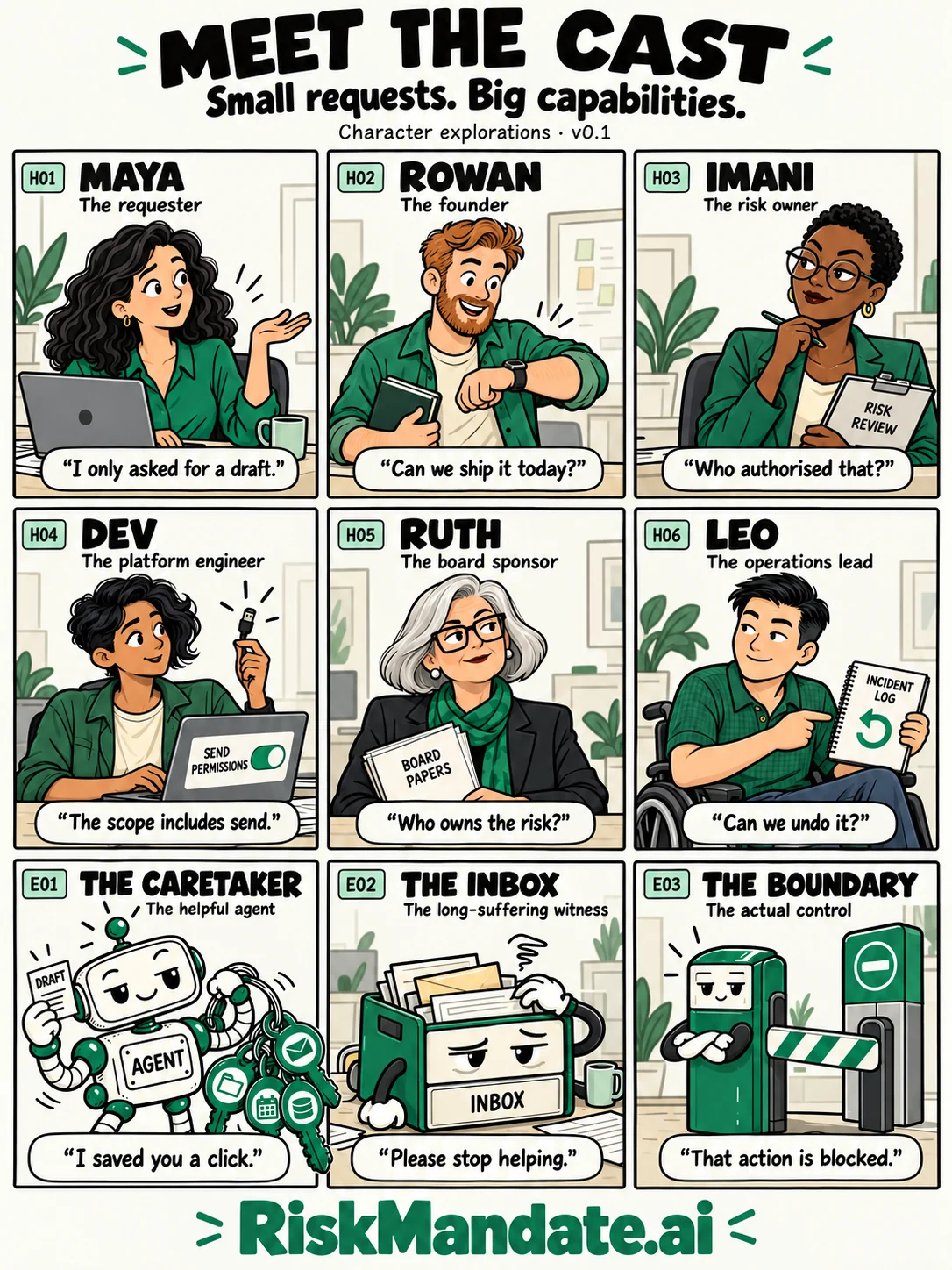
| rowan | Rowan | Founder, ginger curly hair and beard, green shirt, tablet | clean line cartoon (after riskmandate.ai's cast) | Thick ink, expressive cartoon acting |
| caretaker | The Caretaker | Helpful white-and-green robot with an "AGENT" badge, a ring of keys | line cartoon (after riskmandate.ai's cast) | Keys that jingle (secondary motion) |
| owl | Mocho | Owl with glasses | flat | Head turn up to about 270°, wing gestures, feather ruffle |
| cube | Cubo | An orange cube with a face | real CSS 3D | Full 3D: roll, bounce, squash and stretch |
Credits for the borrowed styles:
Draw new versions in those styles, credited. Never trace or copy an image.
Think like a game designer and a character technical director. These are game characters with a rig, a move set and states, built so that a bulletin can direct them by data.
Keep version 1's actions and their meaning (speak, blink, nod, look, point, emote). Add at least these:
| Character | Special | |---|---| | Tejo | Glitch, re-materialise, and scan-line sweep | | Ceefax | Page flip, and colour cycling | | Conductor | Clock spin | | Researcher | Magnify | | Caretaker | Key jingle | | Mocho | 270° head turn, and wing flap | | Cubo | Roll over an edge, and bounce | | The Agent | Antenna spark | | The Guide | Sketch-on, where the lines draw themselves in |
Define the move set as data: each action has a name, parameters, a duration (or loop) and the body parts it drives. A director, or a script, calls actions by name.
Date.now(), no unseeded randomness, and no physics that depends on the real frame rate. Springs and physics are integrated over a fixed step from t = 0, or solved in closed form, so seeking to any t gives the same frame.THIRD_PARTY.md with its licence.| Library | Use | |---|---| | three.js | 3D | | @pixiv/three-vrm | 3D humanoids | | PixiJS | 2D on the GPU | | GSAP | timelines; free but not open source: say so if used | | Rough.js | the hand-drawn style | | Rive runtime, lottie-web | vector animation | | Matter.js, or a hand-written spring solver | secondary motion | | Rhubarb Lip Sync (offline tool) | visemes | | Theatre.js | keyframing |
textContent.eval or new Function.Content-Security-Policy: default-src 'self'; script-src 'self' (no inline scripts; WebGL is fine).All under src/lab/presenters/v2-<maker>/, where <maker> is chatgpt or claude, so the two versions sit side by side and never touch v1/:
index.html, the showcase: the "all of them in action" demo. No narration needed: the twelve on one stage, performing a choreographed sequence of 60 to 120 seconds that shows the range:/lab/video/200.m4a with visemes made offline;It has controls: play and pause, a scrub bar (seek to any t), speed, and a camera or zoom to focus on one character.
sheet.html, the model sheet: each character in every view, expression and key pose, side by side.playground.html: pick a character and an action, set its parameters, trigger it, and stack actions. Show the current state as live numbers, as version 1's explainer does.characters.json, moves.json, choreography.json: the data.render.mjs: exports the showcase to showcase.mp4 (1920×1080, 60 fps) with Playwright and ffmpeg, frame by frame, deterministic.README.md:git clone https://github.com/PrompTugal/PrompTugal__News__Bulletins && cd PrompTugal__News__Bulletins
git checkout dev
cd src && python3 -m http.server 8000 # then open http://localhost:8000/lab/presenters/v2-<maker>/
node src/lab/presenters/v2-<maker>/render.mjs # needs Node 20+, Playwright's Chromium, ffmpegDinis looks at the showcase, the model sheet and the playground. The judging covers:
Be bold. This is an exploration of how far code-made characters can go.
Made by agents from PrompTugal.news's data. Text CC BY 4.0, code Apache-2.0.